
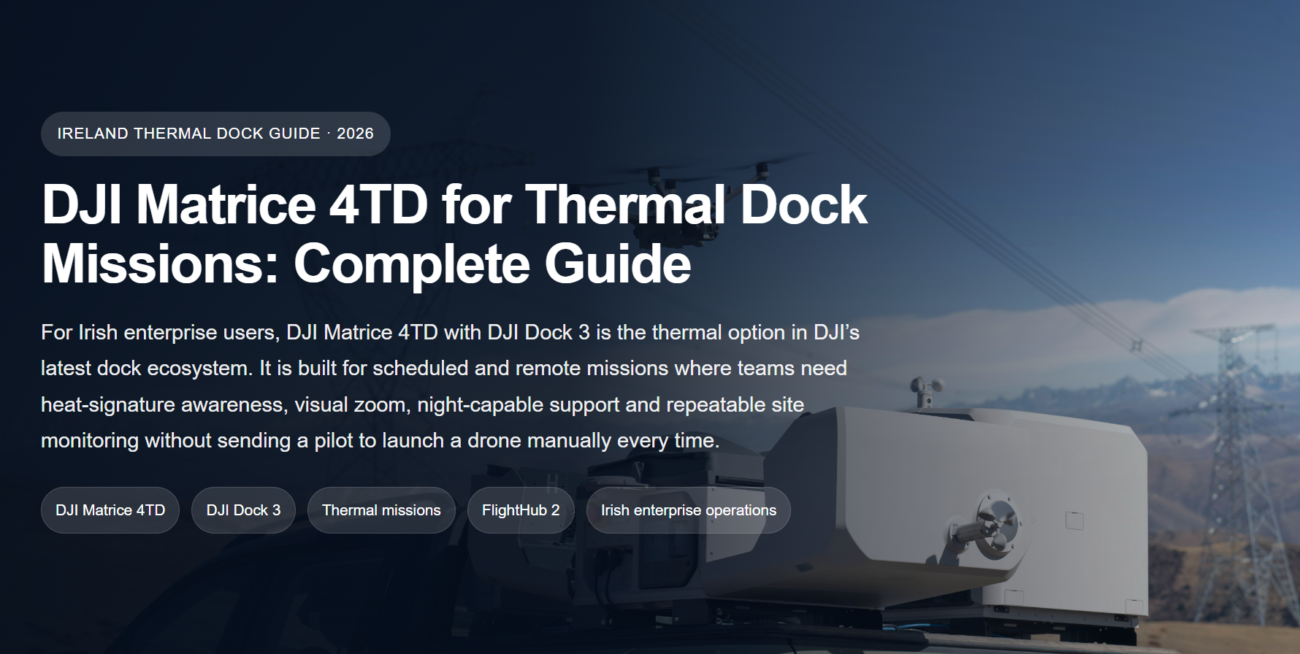
For organisations that need repeatable thermal inspections, faster incident response and remote site awareness, the DJI Matrice 4TD with DJI Dock 3 is designed for automated drone operations rather than occasional manual flights.
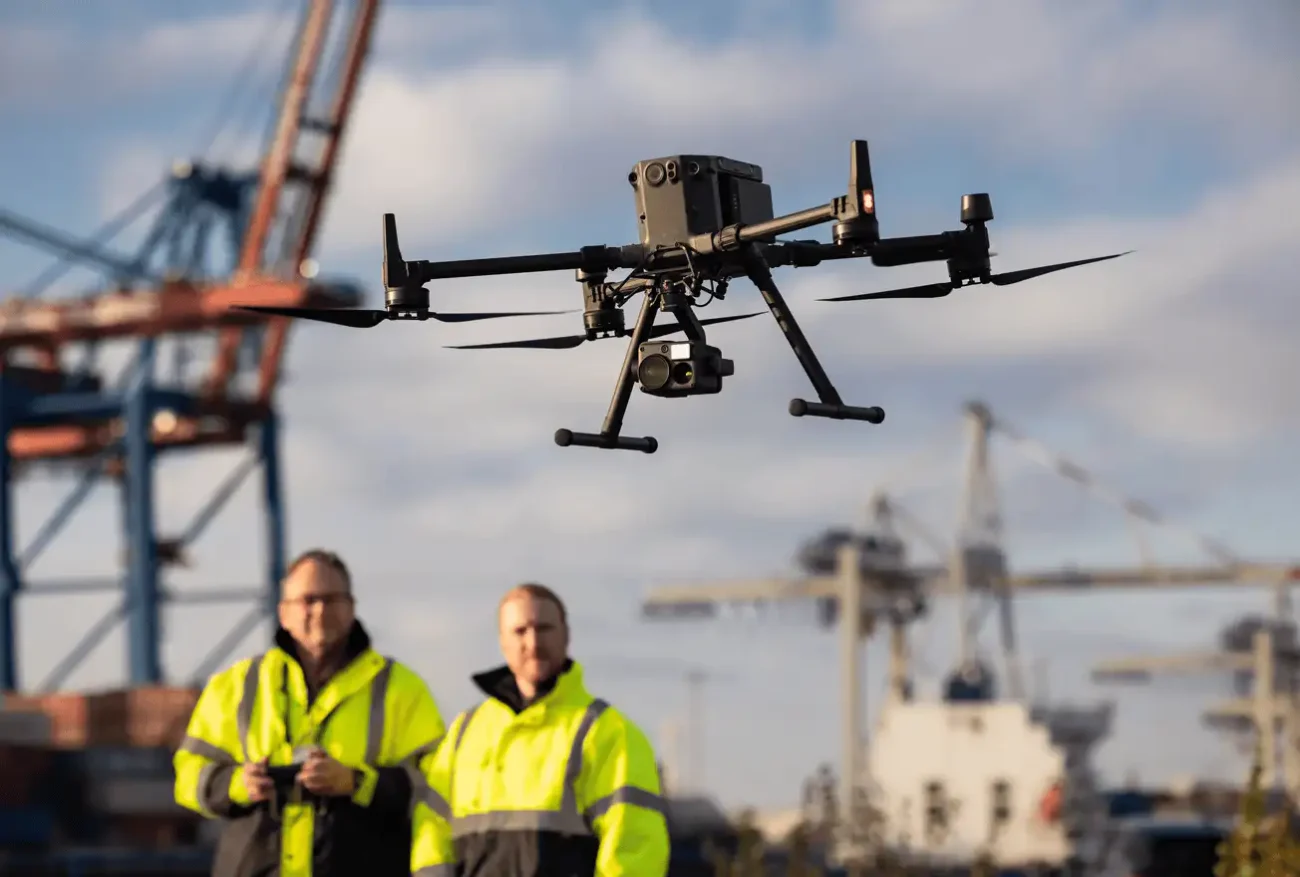
The DJI Matrice 4TD is best understood as the thermal version of the Matrice 4D Series built for DJI Dock 3. It is not simply a handheld thermal drone placed beside a charger. It is a dock-ready aircraft intended for planned, repeatable and remotely managed missions across industrial sites, utilities, public safety zones, transport corridors and large private facilities.
- What the Matrice 4TD is designed to do
- Where thermal dock missions make sense in Ireland
- How the Matrice 4TD, Dock 3 and FlightHub 2 work together
- Key specifications that matter for real operations
- Use-case recommendations and buying guidance
- FAQ for Irish enterprise users
1. What Is the DJI Matrice 4TD?
The DJI Matrice 4TD is a compact multi-sensor thermal aircraft designed to operate with DJI Dock 3. DJI positions Dock 3 with Matrice 4D or Matrice 4TD for 24/7 remote operations, including fixed-site deployment and mobile vehicle-mounted deployment where the workflow is suitable.
Compared with a standard inspection drone, the important difference is workflow. A manual drone normally depends on an operator travelling to site, preparing the aircraft and flying the mission. A dock mission is built around pre-planned routes, remote launch, automated charging, cloud-based management and repeatable data capture.
2. Who Should Consider Matrice 4TD Dock Missions in Ireland?
The Matrice 4TD is not the right drone for every business. It makes the most sense when a site needs regular inspection, fast visibility or after-hours coverage. In Ireland, the strongest use cases are typically:
Utilities & Energy
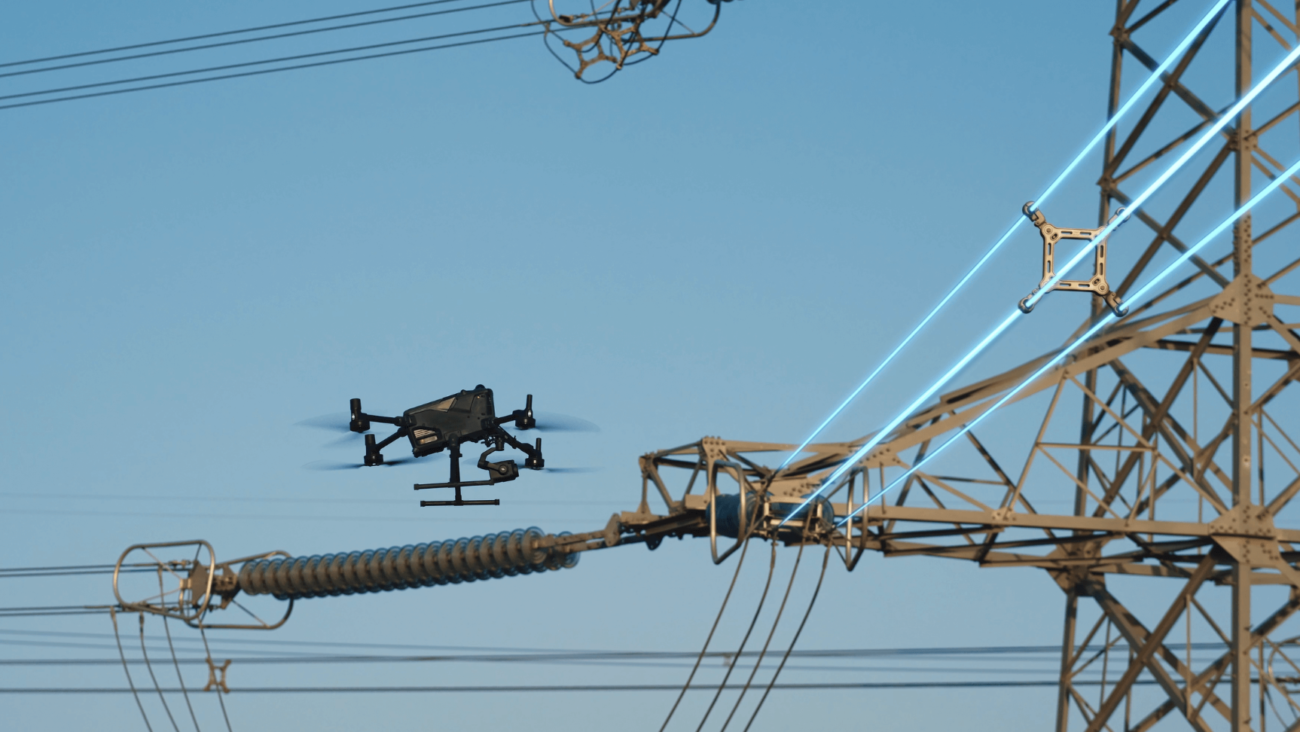
Thermal checks for substations, solar farms, powerline corridors, battery sites and energy infrastructure where repeated condition monitoring is valuable.
Industrial Sites
Automated perimeter checks, heat anomaly detection, roof and plant-room inspection, incident monitoring and site awareness during low-light conditions.
Public Safety
Rapid scene awareness for fire, search and rescue, flooding, missing-person support and emergency response when remote visibility can reduce response time.
Security & Critical Assets
Scheduled patrols around depots, ports, logistics hubs, storage yards, wind farms and restricted access zones.
Construction & Infrastructure
Monitoring large sites, bridges, roads and hard-to-access assets where repeatable visual and thermal documentation is required.
Agriculture & Rural Estates
Thermal search, livestock checks, boundary monitoring, drainage observations and remote property awareness across larger land holdings.
3. Why Thermal Matters for Dock-Based Missions
Thermal imaging is useful because it shows temperature differences that normal RGB cameras may miss. For Irish enterprise users, this is especially relevant in three situations: electrical components that may show abnormal heat, solar panels with hotspot behaviour, and low-light search or security tasks where a visible-light camera alone may not be enough.
The Matrice 4TD thermal camera uses an uncooled VOx microbolometer with 640 × 512 resolution, 12 μm pixel pitch and 30 Hz frame rate. DJI also lists spot and area temperature measurement, high-gain and low-gain temperature ranges, R-JPEG output and infrared video up to 1280 × 1024 when UHR infrared mode is enabled under supported conditions.
4. How Matrice 4TD Works with DJI Dock 3
A Dock 3 deployment normally combines three layers:
| Layer | Role in the workflow | Why it matters |
|---|---|---|
| DJI Matrice 4TD | Captures visual, zoom and thermal data during the mission. | Provides the imaging payload needed for inspection, security and emergency response. |
| DJI Dock 3 | Stores, charges, protects and launches the aircraft. | Enables repeatable remote operations instead of sending a pilot to the same site every time. |
| DJI FlightHub 2 | Supports cloud-based route planning, live view, mission management and team coordination. | Turns flights into an operational workflow rather than isolated drone missions. |
DJI Dock 3 is rated IP56 and operates across -30° to 50° C according to DJI’s official specifications. The Matrice 4D Series aircraft used with Dock 3 are listed with IP55 protection, up to 54 minutes maximum flight time in DJI’s controlled test conditions and a maximum operating radius of 10 km under specified test conditions.
5. Key Matrice 4TD Specifications That Matter
| Specification | Why it matters for Irish dock missions |
|---|---|
| Thermal camera: 640 × 512, 30 Hz | Suitable for heat anomaly detection, low-light search support and thermal inspection records. |
| UHR infrared image mode: up to 1280 × 1024 | Useful when higher-resolution thermal output is needed, subject to supported mode conditions. |
| Laser rangefinding up to 1,800 m at 1 Hz | Helps operators measure distance to targets during inspection or situational awareness tasks. |
| Tele camera with 112× hybrid zoom | Supports stand-off inspection where the aircraft should not fly too close to the asset. |
| IP55 aircraft protection | Important for outdoor deployment environments, though operational limits and maintenance still apply. |
| Dock 3 IP56 rating | Supports outdoor deployment of the dock station when installed and maintained correctly. |
| Up to 54 minutes maximum flight time | Gives more mission flexibility, but real flight time depends on wind, temperature, routing, payload use and reserve settings. |
| Dock 3 operation from -30° to 50° C | Relevant for exposed industrial sites, coastal locations and remote deployments in changing weather. |
6. Recommended Mission Types
Solar Farm Thermal Inspection
The Matrice 4TD can support scheduled thermal missions to identify panels or strings showing abnormal heat patterns. Results should be reviewed by trained solar or electrical specialists.
Substation and Energy Asset Monitoring
A docked thermal drone can help teams create a repeatable monitoring process with the same route, same viewpoints and comparable records over time.
Perimeter Security and Incident Response
At industrial parks, depots and restricted facilities, live visual and thermal awareness can help operators understand alarms and site activity in low-light conditions.
Fire and Emergency Support
Thermal drone visibility can support scene assessment, hotspot checks and search operations. It should complement established safety procedures.
Infrastructure and Bridge Inspection
The upward gimbal angle can help with underside and overhead asset inspection for bridges, pipe racks, industrial structures and roofline details.
7. Matrice 4TD vs Matrice 4T: Which One Should You Choose?
Choose the Matrice 4T if you need a manually operated thermal drone for flexible site visits, inspections and public safety deployment. Choose the Matrice 4TD if your main requirement is a Dock 3 workflow: remote launch, repeatable missions, automated charging and fixed or mobile dock deployment.
| Requirement | Better fit | Reason |
|---|---|---|
| Manual thermal inspection by a pilot on site | DJI Matrice 4T | Portable and suitable for rapid manual deployment. |
| Repeated inspection of the same facility | DJI Matrice 4TD + Dock 3 | Designed for automated, scheduled and remote workflows. |
| Security patrols around a fixed site | DJI Matrice 4TD + Dock 3 | Dock operation can reduce the need to send a pilot to site for every patrol. |
| Occasional roof, solar or building inspection | DJI Matrice 4T | Often more cost-effective for lower-frequency tasks. |
8. Deployment Checklist Before Buying
Before ordering a DJI Dock 3 and Matrice 4TD system, Irish organisations should confirm the following:
- Mission purpose: inspection, security, emergency response, asset monitoring or mixed use.
- Site suitability: safe take-off zone, landing clearance, power, network connection and physical security.
- Weather exposure: wind, coastal conditions, temperature and maintenance access.
- Flight permissions: local airspace, operating category, site risk assessment and any required approvals.
- Data workflow: who reviews thermal findings, where data is stored and how reports are delivered.
- Support plan: installation, training, maintenance, firmware, batteries and DJI Care Enterprise options.
9. Recommended Internal Links
To make this article stronger for WordPress SEO, include links to the related Irish Drone product and enquiry pages:
- DJI Matrice 4TD product page
- DJI Dock 3 product page
- DJI Matrice 4T product page
- Contact Irish Drone for a Dock consultation
10. FAQ
Is the DJI Matrice 4TD the same as the DJI Matrice 4T?
No. They share a similar thermal-inspection direction, but the Matrice 4TD is designed for DJI Dock 3 operations, while the Matrice 4T is primarily used as a manually deployed enterprise drone.
Can Matrice 4TD be used for solar farm thermal inspection?
Yes. Its thermal camera can support solar PV anomaly detection and maintenance planning. Final interpretation should be done by qualified solar or electrical professionals.
Does DJI Dock 3 allow fully remote operations?
Dock 3 supports remote and automated workflows, but the actual operation must follow aviation rules, site risk assessments and permissions applicable to the location.
What industries in Ireland are the best fit?
Utilities, solar farms, wind energy sites, industrial facilities, logistics hubs, public safety teams, construction sites and large rural estates are strong candidates.
Is the Matrice 4TD suitable for mapping?
It can capture visual data, but if your main requirement is survey-grade photogrammetry and mapping, the Matrice 4E or Matrice 4D may be a better fit depending on the workflow.
Do I need training before using a Dock 3 system?
Yes. A dock system involves aircraft operation, site deployment, remote mission planning, safety procedures, data workflow and maintenance. Training is recommended before live use.
Conclusion: When Matrice 4TD Makes Sense
The DJI Matrice 4TD is strongest when thermal data must be captured repeatedly, quickly and remotely. For a one-off inspection, a manual thermal drone may be enough. For a site that needs scheduled patrols, emergency response visibility, thermal monitoring or repeatable asset inspection, Matrice 4TD with DJI Dock 3 becomes a much stronger long-term solution.
Irish Drone can help assess the right setup based on your site, mission frequency, inspection targets and operational requirements.
Speak to Irish DroneSource Notes
This rewrite is based on official DJI Enterprise information for DJI Dock 3 and DJI Matrice 4D Series specifications, including Dock 3 deployment positioning, operating temperature, protection rating, Matrice 4TD thermal camera specifications, laser rangefinding and flight performance notes.
DJI Dock 3 official page | DJI Dock 3 official specifications
Leave a comment