
A complete package is complete for a stated task and scope. It is not simply an aircraft with a charger, and it is not an operating permission.
Define what “complete” must mean for your job
Start a package enquiry with the transport requirement: the prepared load, route, receiving method, proposed duty window and available site power. Without those details, “complete” can mean little more than a collection of compatible products. It cannot establish that the equipment supports the intended day’s work.
Separate hardware, commissioning, training, recurring services, transport and operating permissions in the quotation. State which parts are supplied, which require separate arrangements and which remain unresolved. Do not assume that a demonstration, software subscription or regulatory application is included because the package has a comprehensive name.
The written scope should also distinguish a confirmed regional configuration from a planned enquiry. T200 and FC200 remain contact-for-quotation routes. A live catalogue page provides a useful specification reference; it does not prove European conformity, Irish availability or a delivery date.
Use an equipment list with totals, not ambiguous additions
For each line, state the exact model, quantity and whether it is fitted to the aircraft or supplied separately. Flight batteries should be expressed as the total supplied, including any provided with the base aircraft. “Two batteries” must not quietly become two additional batteries on top of an assumed pair.
Apply the same rule to controllers and safety assemblies. If a specified parachute assembly is already fitted or supplied with the airframe, count the required total once rather than accidentally ordering a second. Distinguish controller batteries and small USB chargers from the equipment that powers and charges the aircraft.
Ask for exact regional revisions and necessary leads or adapters. The FC30 specifications name the DB2000 battery and its C8000 configuration. A different agricultural product with a similar charger name is not an acceptable substitute merely because its headline wattage sounds suitable.

Compare the actual listed cargo configurations
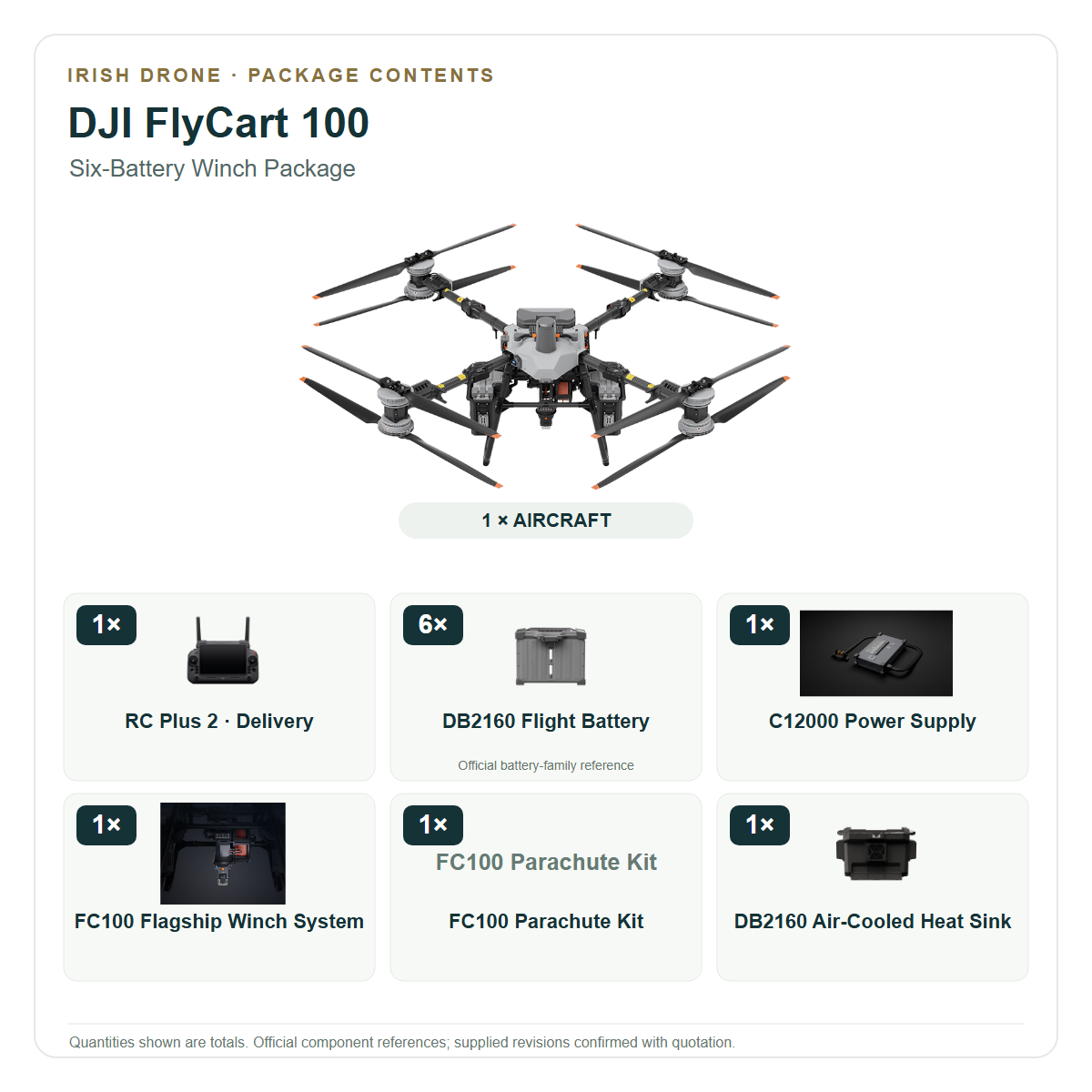
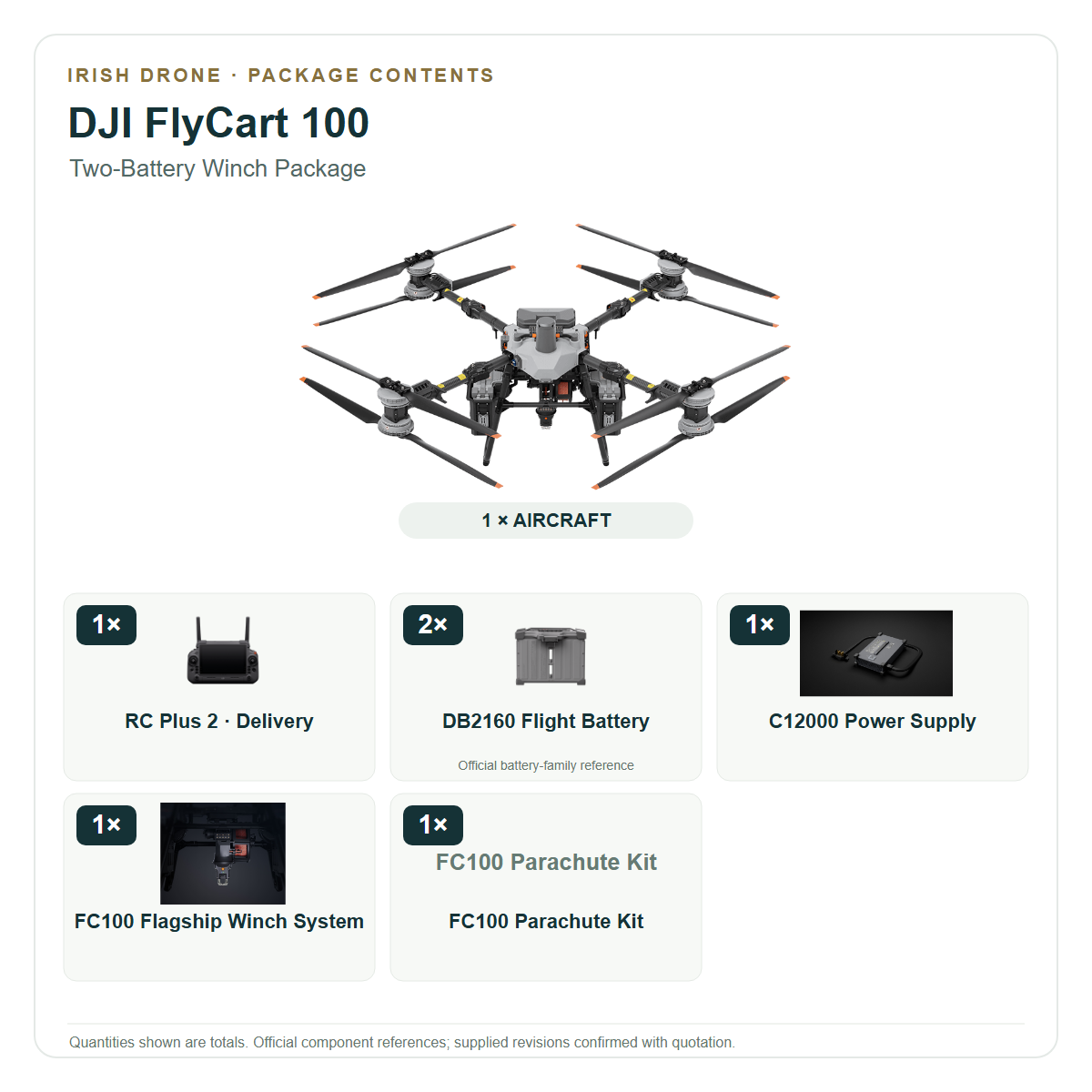
The FC30 Two-Battery Winch Package specifies two total DB2000 flight batteries, the FC30 C8000 charging configuration and the FC30 winch. For FC100, the Two-Battery Winch Package and Six-Battery Winch Package use the named DB2160 family, C12000 and FC100 flagship winch, with their own itemised lists.
The six-battery list adds rotation inventory and a listed cooling accessory; it does not promise that one charger can replenish three pairs fast enough for every route. Read the exact contents and notes instead of inferring quantity or compatibility from the package illustration.
The FC200 Four-Battery DL200 Configuration uses four total DB2400 batteries, the specified C18000 route and DL200. It remains a planned, quote-only configuration; the powered-winch alternative is a different selection, not an included second working system.
Make the electrical and fuel support scope explicit
Identify the actual charging location and power source before accepting the package. A charger’s maximum rating does not describe every site connection. The FC100 data distinguishes C12000’s specified three-phase and single-phase outputs, and its fast-charging reference includes a particular charge window and temperature conditions.
For FC200, the Chinese C18000 specification identifies a mains-input charger, its separate input conditions and sequential/parallel charging references. It is not a fuel generator. Confirm the regional charger, supply, leads and battery connection before treating that planned arrangement as ready for use.
Where generator charging is proposed, list the exact approved equipment and electrical route. Keep dedicated DC charging separate from an auxiliary AC socket. Fuel, maintenance, safe positioning and the competent provision of the supply belong in the operational support plan rather than being assumed from a charger included in the box.
Accept the identity and documentation before a flight exercise
At handover, reconcile the aircraft and supplied accessories with the quotation. Record relevant model and serial details, battery identities, controller configuration and the manuals applying to the actual regional units. Identify any substituted item and resolve it before accepting the configuration.
Request the applicable conformity and operating documentation without assuming that a global product page supplies it. Agree who is responsible for activation, firmware configuration, maintenance records and any services that require an account or subscription. A working login is not evidence that a recurring service is included indefinitely.
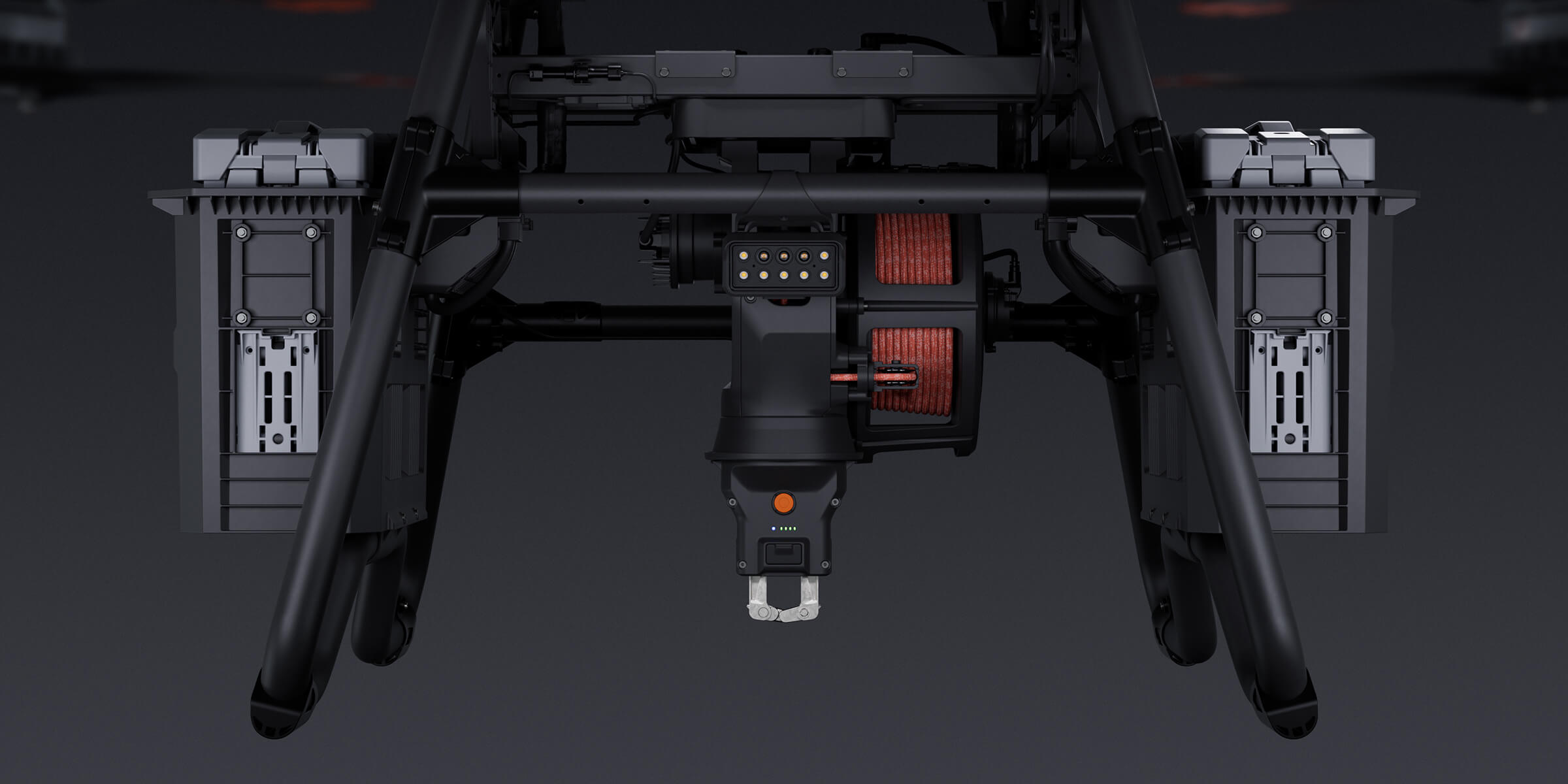
DJI’s FC100 flagship winch information states the aircraft compatibility and inspection requirements for that system. Use the corresponding exact-model documents for every working system supplied. A generic “DJI winch” entry on a handover sheet is not sufficiently precise to verify what was commissioned.
Agree observable acceptance checks in advance
Write acceptance checks that answer the proposed task: the complete load can be prepared and identified, the selected working system is correctly fitted and inspected, the crew understands the receiving sequence, and the charging arrangement operates within its specified conditions. Identify who witnesses each check and what evidence will be retained.
Separate static checks, ground rehearsals and any authorised flight exercise. A photograph of assembled equipment does not prove route performance; an isolated successful flight does not prove the sustained battery cycle. Conversely, a useful ground rehearsal can expose a communication or receiving problem without placing a load in the air.
Where emergency responses need assessment, choose an accepted safe exercise method rather than inventing a hazardous live fault. The commissioning plan should state stopping criteria and how unresolved findings are closed, not only a list of attractive features to demonstrate.
Give each unresolved finding an owner and an agreed way to demonstrate closure. If a replacement component or different regional revision is proposed, update the equipment list and repeat the affected check. Do not mark the whole handover accepted merely because unrelated checks passed, or confuse a signed delivery receipt with acceptance of the intended operating configuration.

Keep aircraft acceptance and operating permission separate
The IAA operational-authorisation guidance asks customers to check appropriate registration, authorisations, remote-pilot competence and insurance. A completed equipment handover does not create those permissions. The operator’s actual aircraft, configuration, route and method must fit its operational case.
Also separate land or asset cooperation from aviation authority requirements. A site manager’s approval to receive goods does not alone settle the flight, and an aviation authorisation does not automatically settle every site-access or environmental question.
Use the SORA, training and emergency-planning articles alongside the hardware review. They should help identify responsibilities and evidence, not be described as benefits automatically bundled into a purchase. No package name guarantees that an application will be approved or that commissioning can occur on a promised date.
Illustrative buying decision: identify what the quote still lacks
Illustrative procurement example: a buyer asks for repeated powered-lowering deliveries and compares a two-battery FC100 package with a six-battery package. The important difference is not simply the number printed in the name. The buyer records that both use two batteries simultaneously and asks how the proposed charger and site supply support the intended dispatch interval.
The review finds two unresolved items: the receiving procedure has not been agreed, and the available electrical connection has not been confirmed. More batteries do not resolve either issue. The quotation and commissioning plan are completed only after those dependencies are addressed.
Use the same method for your enquiry: send the transport brief, request an exact equipment list with total quantities and agree acceptance evidence. Review a dated written quotation for commercial scope. Do not convert an indicative market reference into an assumed final selling price, stock commitment or guaranteed operational result.
Frequently asked questions
Does “complete” mean training and operating approval are included?
Only items and services expressly included in the written quotation are included. Hardware acceptance does not grant an operating authorisation.
Are package battery quantities additional to an assumed factory pair?
No. The supplied configurations state total flight-battery quantities; any factory-supplied units must be counted within that total.
Can an indicative price be treated as the final quote?
No. Confirm the current written quotation, exact configuration and commercial scope; do not infer stock or delivery commitments.
Explore the aircraft and packages
Follow the product page for the exact configuration and included equipment. Equipment selection and operating authorisation are separate parts of the project.
Talk to Irish Drone about your project
Send us the site, task, load or application material, intended operating pattern and available charging supply. We can help scope a suitable aircraft and package and discuss the preparation needed for an Irish operation.
Contact usPlan the next part of your operation

Official sources and technical guidance
These links support specific facts in the guide. Check the current revision and operating conditions when preparing a real project.
DJI’s Chinese-market T200 and FC200 references may require China Mainland to be selected in the official site’s region settings; the default region can display a not-found page. Their regional technical data does not establish an Irish configuration or operating approval.




Leave a comment