

Start with what must move, where it must arrive and how the receiving team can safely accept it. Aircraft size comes after those decisions.

Match the delivery method to the job
Use the task and receiving arrangement to build a shortlist, then ask for the exact equipment configuration. Package links are starting configurations for a quotation.
On smaller screens, scroll the table sideways to compare all four columns.
| Your task | Starting candidates | Check before choosing | Existing package options |
|---|---|---|---|
| A boxed consignment for a receiving point that can be reached safely | DJI FlyCart 30 | Weigh the complete consignment and agree the receiving procedure. Do not assume a cargo case is included in the linked battery-and-charger package; confirm the handling equipment in your quotation. | FlyCart 30 two-battery power package |
| Lowering a load while the aircraft remains airborne | DJI FlyCart 30 DJI FlyCart 100 | Review the complete suspended assembly, cable path and controlled receiving area. Use the correct aircraft-specific winch; the FC30 and FC100 winch systems are not interchangeable. | FlyCart 30 winch package FlyCart 100 two-battery winch package |
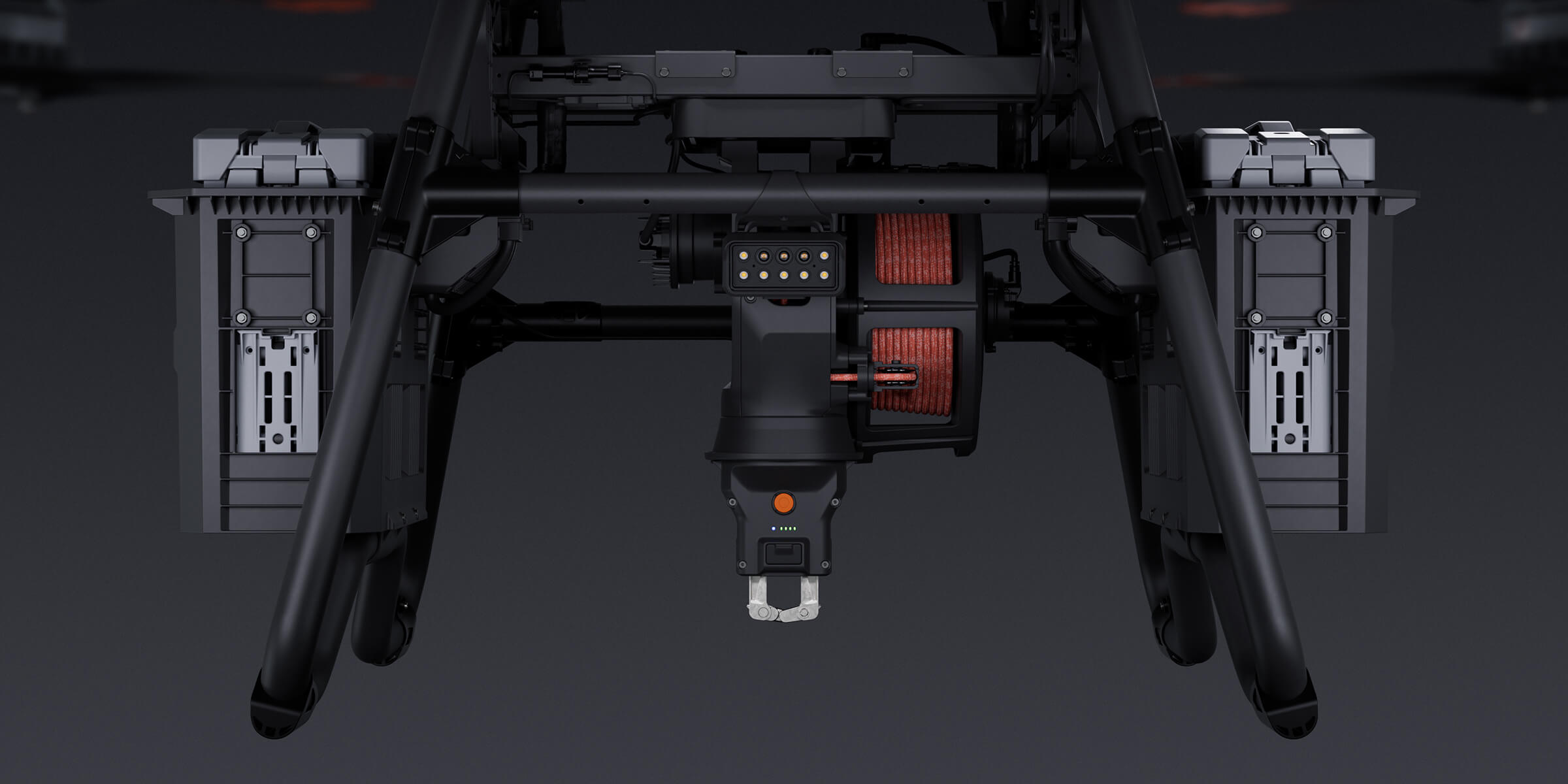
| Repeated lifting cycles with a planned battery rotation | DJI FlyCart 100 | Test charging output, cooling, replenishment and turnaround against the actual job. A six-battery inventory does not establish uninterrupted operation or a fixed delivery window. | FlyCart 100 six-battery winch package |
| A proposed remote construction or utility-material lift needing a different configuration assessment | DJI FlyCart 200 Regional configuration enquiry | Confirm the load and route first, then the battery mode, fixed-cable or winch system, regional supply and conformity documentation. A listed package is not evidence of Irish operating approval. | FlyCart 200 four-battery DL200 configuration FlyCart 200 four-battery winch configuration |
Manufacturer payload or endurance tests are not an allocated delivery window. Confirm the complete setup and the Irish operating route before planning the job.
Describe the job before comparing aircraft
A useful FlyCart comparison begins with a consignment, not a maximum kilogram figure. Record the item’s measured mass, its packaging, attachment hardware, dimensions and behaviour when suspended. A compact sealed box and a long flexible bundle can create very different handling problems despite weighing the same. Then describe the loading and receiving areas, the climb between them and what happens if the receiver cannot accept the delivery.
Separate the essential item from the batch. A job involving many small components might be divided into manageable consignments; an indivisible assembly cannot. That distinction can change the aircraft shortlist more decisively than an attractive range claim. The heavy-lifting drone range is a starting point for that conversation, not evidence that every listed model is suitable for an Irish operation.
Write a one-page transport requirement that a pilot, site manager and equipment supplier can all challenge before a quotation is finalised.
Where FlyCart 30 enters the shortlist
DJI FlyCart 30 provides a useful lower-load reference within this group. DJI lists 30 kg in dual-battery operation and a separate 40 kg single-battery configuration. Its published loaded dual-battery flight test is 18 minutes with 30 kg; that is a controlled reference, not an allocated delivery window. The conditions and the distinction between flight and hover belong alongside the numbers, as shown in DJI’s specifications.
Its cargo-case and optional winch workflows make the receiving method important. A site where the aircraft can land and the goods can be handled in a controlled area is different from a site requiring lowering while the aircraft remains above it. Check the exact equipment supplied rather than treating a photograph of a winch as an included item.
Do not select the single-battery figure simply to make an overweight consignment appear to fit. The configuration, reserve, manual and proposed operating case must be assessed together.

Read FlyCart 100’s two different comparisons correctly
DJI FlyCart 100 has a higher payload class, but two sets of figures must remain separate. The current FAQ describes up to 85 kg with dual batteries and explains that specified dual-battery hardware, cable and hook are included in that payload accounting. The application’s recommended loading value still governs the job. Those details are in the official payload FAQ.
The global specifications also publish a 149.9 kg take-off-weight test: 12 km and 14 minutes in dual-battery forward flight, with different hover figures. It is incorrect to attach that distance automatically to the 85 kg headline. The figures were produced under stated conditions and to battery depletion. DJI identifies single-battery operation as emergency use.
For procurement, the larger platform therefore changes both the lifted-load calculation and the ground support required. It does not turn the lighter platform’s mission plan into a valid heavier one merely by replacing the aircraft name.
Treat FlyCart 200 as a regional configuration enquiry
The current official Chinese FlyCart 200 material describes a 200 kg platform with two- or four-battery DB2400 operation. Its published loaded hover references are seven minutes with four batteries and four minutes with two, measured at equivalent sea level, 25°C and no wind until depletion and forced landing. These are hover tests, not climbing-duration promises. The Chinese regional specifications are the source for those conditions.
That information can help define a heavier transport enquiry. It does not establish European conformity, Irish supply or a suitable operational authorisation. Our comparison deliberately keeps those questions open. A model’s appearance in a catalogue is not a substitute for the regional technical documentation and the operator’s own regulatory case.
FlyCart 200 remains a contact-for-quotation route. Ask for the exact proposed regional aircraft, working system, battery count, charger and documentation before comparing it with an available configuration of another model.

Choose the delivery method alongside the aircraft
Landing delivery, a powered winch and a fixed-cable lifting system solve different receiving problems. Start by asking whether a prepared landing area is genuinely available after people, loose materials, vehicle movements and rotor clearance are considered. If not, evaluate the full lowering or suspended-load volume, including cable and load movement, rather than only the aircraft’s footprint.
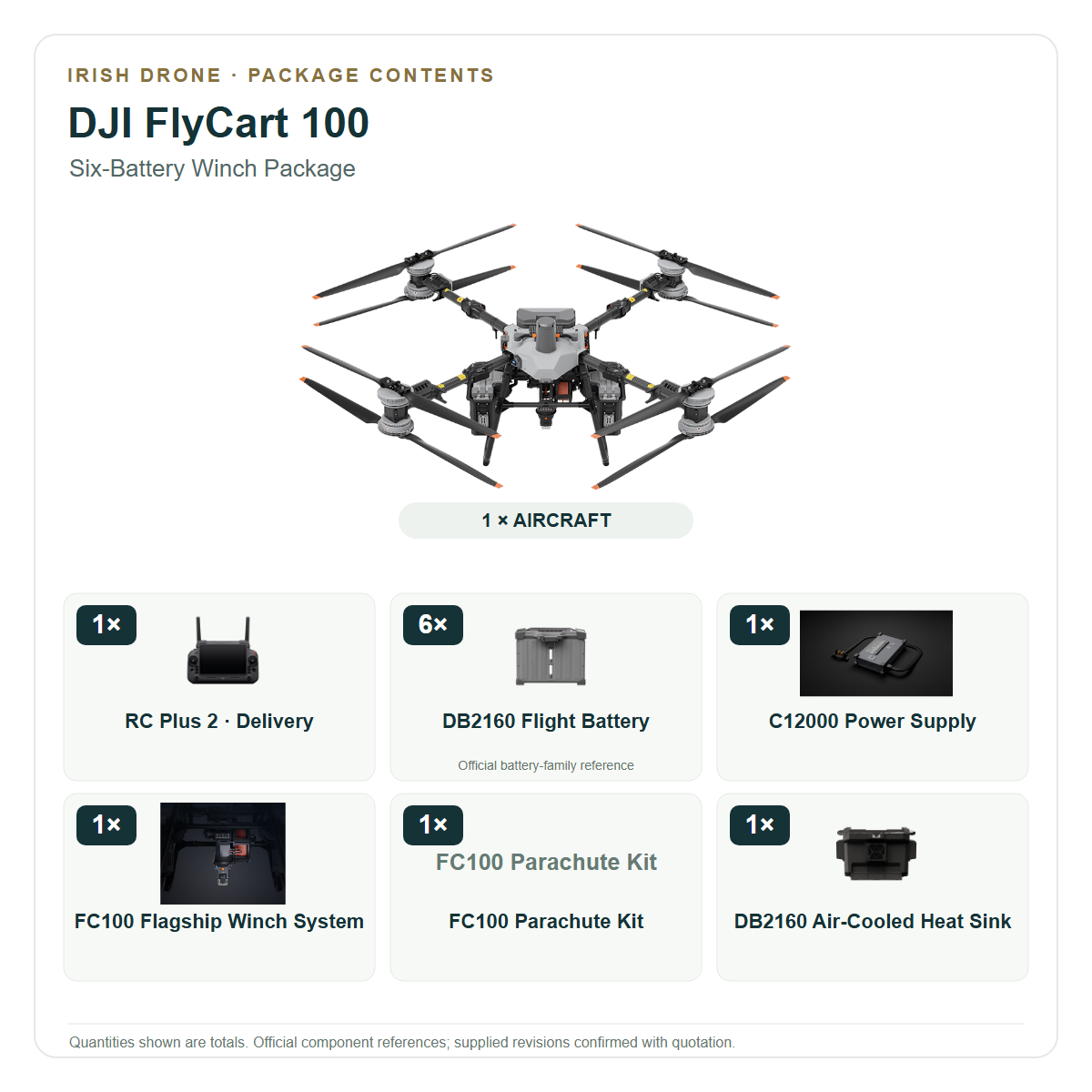
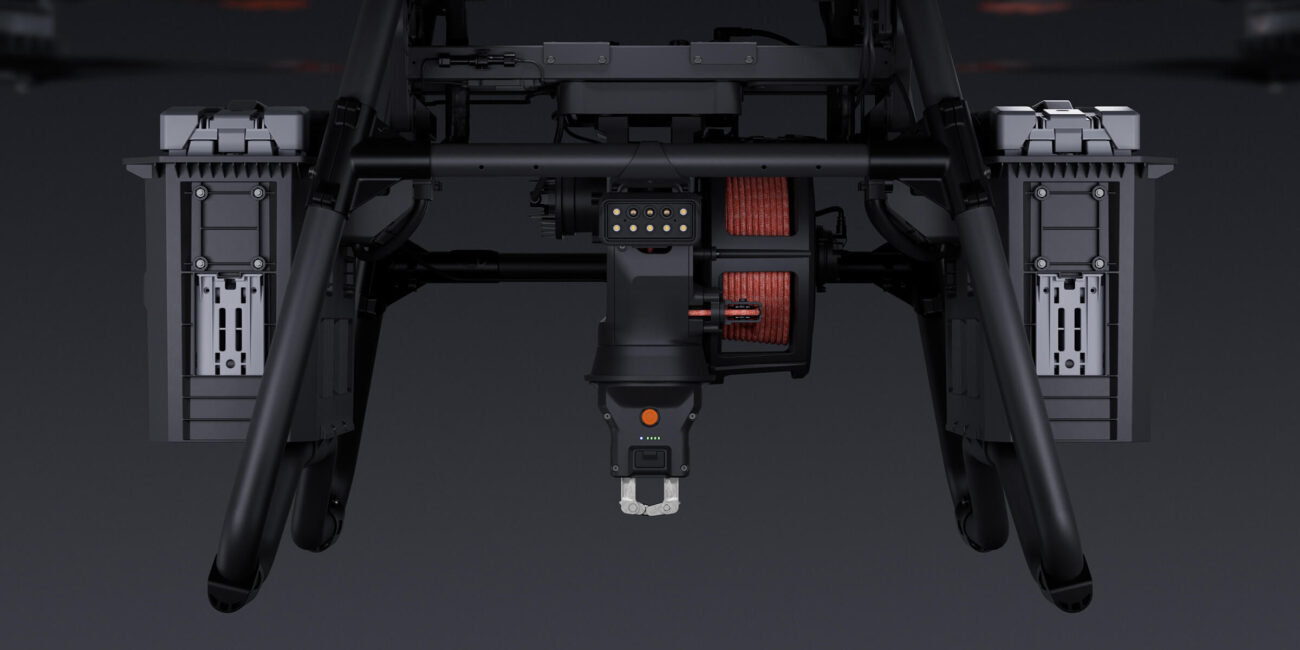
FlyCart 100’s powered flagship winch and its dual-battery lifting system are separate working systems. The FlyCart 200 DL200 and its own powered winch are another model-specific choice. Similar product names do not make assemblies interchangeable. In particular, DJI states that the FC30 and FC100 winches are not interchangeable in its payload-system guidance.
Complete the receiving procedure on paper first: who gives the all-clear, who can stop the delivery, how the item is released and when the team may approach. An equipment feature supports that procedure; it does not replace it.
Check the two constraints that a payload table misses
The first constraint is the energy cycle. Count batteries simultaneously required in the proposed mode, then calculate complete operating sets. A six-battery dual-battery package represents three pairs; three individual batteries do not. Charging power, cooling, inspection and the time to prepare the next consignment may determine the sustained work rate.
The second constraint is the full operating case. Payload capacity, a product listing and a technical flight radius do not establish permission to fly. These heavy configurations require an operation-specific assessment rather than an assumption that a catalogue entry establishes an Open-category route. The EASA Specific-category guidance explains that higher-risk operations can fall into Certified and that geographical-zone permission may be separate. Do not assume that a CE radio transmission figure or a supplier’s European page establishes permission for a particular lift.
Keep the aircraft specification, the package contents and the operational authorisation as three separate records. Each must match the actual job, but none proves that the other two are complete.
Illustrative comparison: a remote maintenance consignment
Illustrative planning example, not a measured flight: a maintenance team needs several boxed parts and one larger, indivisible assembly at an uphill site. The small boxes could be split into separate consignments after their complete lifted mass is measured. The larger assembly cannot be divided merely to fit a preferred aircraft.
The sensible comparison asks whether each proposed consignment fits the recommended loading value, whether the receiving point supports landing or lowering, and whether the return and contingency route can be demonstrated with reserves. It also asks whether bringing charging equipment to the launch site is practical. A larger aircraft may resolve the indivisible-load issue while making transport, power and site control more demanding.
No saving or completed trip count follows from those facts alone. The next decision is a controlled feasibility assessment using the operator’s proposed route and equipment, not an assumption that the largest payload automatically produces the best outcome.
Build a shortlist that can be quoted and tested
Present the supplier with the consignment register, route sketch, receiving method and proposed operating mode. Ask for a written configuration showing total flight batteries, exact battery and charger models, controller configuration, working system and any necessary leads or ground equipment. Separate optional items and recurring services.
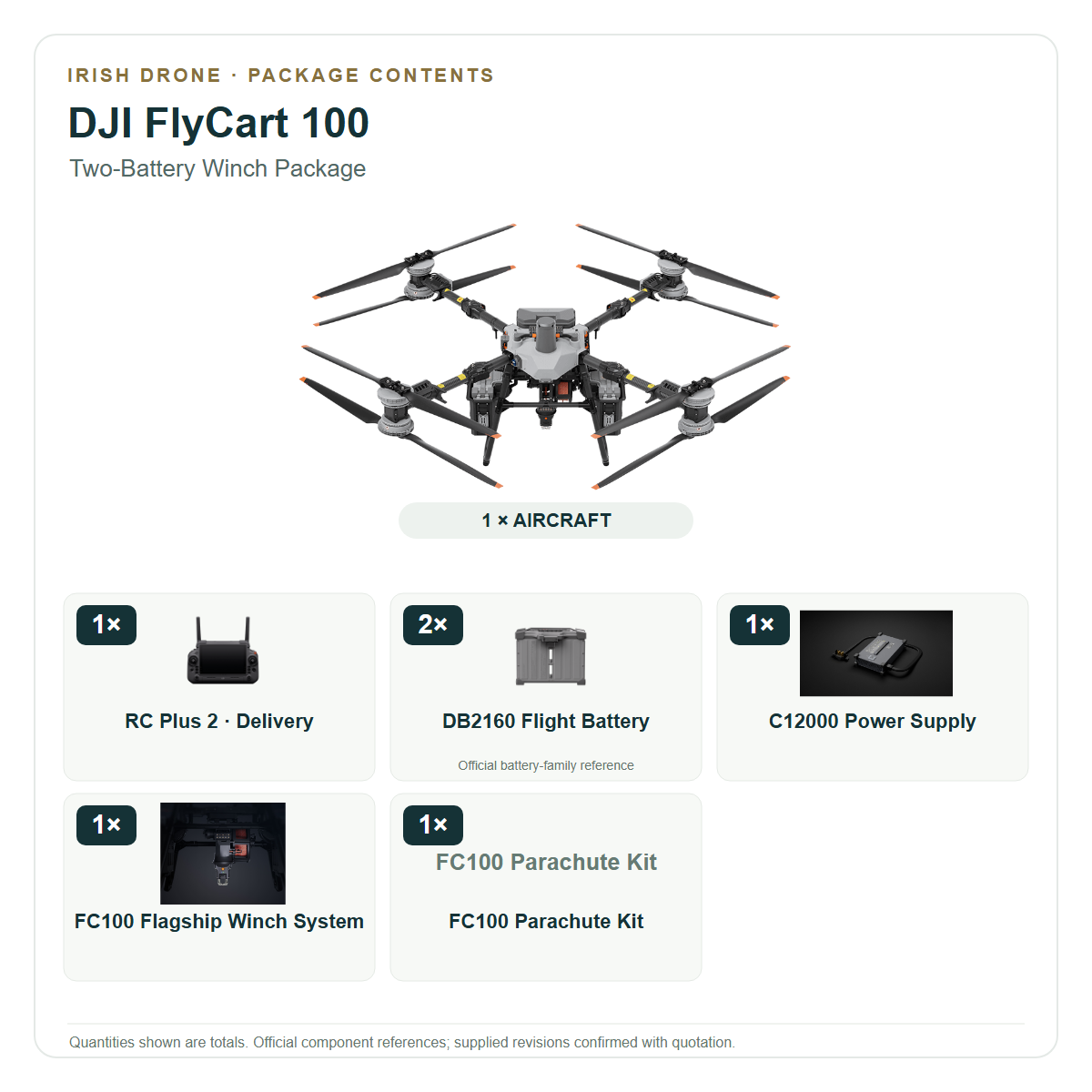
The FlyCart 100 Two-Battery Winch Package is one concrete configuration to review when powered lowering and that aircraft’s load class are relevant. Compare its listed contents with the actual duty cycle rather than assuming that one installed pair is a rotation inventory.
Before accepting a recommendation, agree what the commissioning exercise must prove: secure load handling, the proposed delivery sequence, energy margins, crew communication and an orderly stop when conditions change. Use the separate training, emergency-planning and SORA guidance to complete the operating case. The result should be a defensible shortlist, including a reason to decline a model when the task does not fit.
Frequently asked questions
Does the biggest payload identify the best aircraft?
No. The indivisible load, receiving method, route, energy cycle and operational case must all fit.
Is FlyCart 200 confirmed for an Irish delivery operation?
No. The article uses Chinese regional technical references. Supply, regional configuration and operating suitability require a specific quotation and assessment.
Explore the aircraft and packages
Follow the product page for the exact configuration and included equipment. Equipment selection and operating authorisation are separate parts of the project.


Talk to Irish Drone about your project
Send us the site, task, load or application material, intended operating pattern and available charging supply. We can help scope a suitable aircraft and package and discuss the preparation needed for an Irish operation.
Contact usPlan the next part of your operation
Official sources and technical guidance
These links support specific facts in the guide. Check the current revision and operating conditions when preparing a real project.
DJI’s Chinese-market T200 and FC200 references may require China Mainland to be selected in the official site’s region settings; the default region can display a not-found page. Their regional technical data does not establish an Irish configuration or operating approval.



Pingback: Remote-Site Cargo Drone Feasibility | Irish Drone