
Count complete operating sets first. Then measure whether charging can replace the energy used by the next dispatch; extra batteries provide a buffer, not unlimited operation.
The missing word in a three-battery rotation is “set”
The familiar idea of one battery flying, one charging and one cooling is only a useful starting picture when one individual battery is the normal installed requirement. It cannot be transferred unchanged to an aircraft that uses two or four batteries together. The unit of flight planning is the complete approved operating set.
For normal dual-battery FC100 work, three individual flight batteries provide one complete pair and one unpaired spare. They do not provide three ready flights or three independent stations. DJI labels FC100 single-battery mode as emergency use in the current specifications; it should not be adopted as a productivity workaround to make a small battery inventory seem sufficient.
A complete set also needs compatible, serviceable batteries that meet the exact pairing requirements. Merely finding two charged units in the vehicle does not establish an acceptable pair.
Count individual batteries and simultaneous requirements separately
Use a simple inventory calculation: complete sets = whole-number part of compatible, ready individual batteries ÷ batteries required simultaneously. Keep unpaired spares visible rather than hiding them inside a rounded set count.
| Proposed mode | Installed requirement | Three individual batteries | Three complete sets need |
|---|---|---|---|
| FC30 dual-battery | 2 DB2000 | 1 pair + 1 spare | 6 DB2000 |
| FC100 normal dual-battery | 2 compatible flight batteries | 1 pair + 1 spare | 6 compatible flight batteries |
| FC200 four-battery | 4 DB2400 | No complete four-battery set | 12 DB2400 |
These are inventory arithmetic, not recommended purchase quantities. The exact battery family and operating mode remain model-specific. The Chinese FC200 specifications describe two- and four-battery operation; choosing between them also changes the aircraft’s flight-performance case.
Controller batteries, including a WB37 where applicable, are separate. A controller charger is not a flight-battery charger and its battery must never inflate the count of available aircraft sets.

Read the charging reference before building the timetable
Charging time must include its starting charge, ending charge, temperature and available power. For FC30, DJI’s battery FAQ gives approximately 36.6 minutes for two batteries from 0% to 98% at normal temperature with two AC power cables connected. That cannot be compared directly with a different aircraft’s partial-charge fast-charging window.
For FC100, the C12000 reference is nine minutes from 30% to 95% at sea level and ambient 15–40°C, with fast charging supported within the stated battery-cell temperature range. The specification lists one output channel. That does not mean a complete pair is replenished in nine minutes by that one channel.
Do not combine a flight test ending at 0% with a charger test starting at 30% and call the result a closed operating cycle. An actual dispatch plan must connect the same charge windows and reserve policy.
Compare charging service demand with the dispatch interval
Illustrative arithmetic, not a field result: suppose two returned batteries each require a nine-minute charge task under the published reference conditions. One effective charging output must provide 2 × 9 = 18 minutes of charging service for that pair, before handling or additional waiting is considered.
Now suppose the proposed operation aims to dispatch a pair every ten minutes. One output cannot sustainably provide eighteen minutes of charging work during each ten-minute interval. Three pairs can delay the first wait, but they do not remove that capacity shortfall. Actual charge time, cooling and the available supply may make it larger.
For comparable charge tasks, a useful screening expression is charging service per flight = installed battery count × measured charge time per battery ÷ effective parallel outputs. It is not a complete production model. Cooling, unequal battery states, shared-power limits and charger scheduling must still be recorded.

Give cooling, inspection and rejected batteries a place in the cycle
Build a visible status system for each numbered battery: ready, installed, awaiting inspection, cooling, charging or removed from service. Record which units were flown together, their arrival state and whether the charger delayed or limited charging. The crew should not have to infer readiness from where a battery happens to be standing.
Temperature-controlled fast charging is not an instruction to force a hot battery into service. Follow the exact battery, cooling accessory and charger instructions. If a unit is damaged, gives a warning or does not meet pairing conditions, exclude it from the ready inventory and recalculate the available complete sets.
Position the charging process so it can be supervised without interfering with loading, aircraft movements or the receiving communications. A heat sink is a cooling accessory, not another battery and not an additional charging output.
Separate a generator’s dedicated DC charging from its AC socket
The D14000iE listed in FC100’s specifications has a dedicated DC charging output rated at 11.5 kW and a separate 220 V, 1.5 kW AC output. It is wrong to treat that auxiliary AC socket as a 12 kW supply for a C12000 charger. The output labels describe different electrical routes.
Confirm the exact regional generator, battery, leads and firmware before configuring the system. Do not substitute a similarly named agricultural charger or assume that a generator shown beside another aircraft is compatible. C18000 is a mains-input charger, not a fuel generator.
Use the D14000iE user manual for the actual fuel, oil, operating, maintenance and refuelling procedure. Plan ventilation, fire control and fuel handling as part of the ground setup. Refuelling and service interruptions belong in the productivity timetable; a full fuel tank is not permission for unlimited work.
The site supply can change the result more than another spare
C12000’s published output is 12 kW on its specified three-phase input and 3 kW on the specified single-phase input. Those are not interchangeable conditions for the nine-minute charging reference. Ask the competent person responsible for the supply to confirm the actual connection, available power and suitable leads.
FC200’s Chinese C18000 reference separately gives seven-to-eight-minute sequential and twelve-to-thirteen-minute parallel charging figures for 30%–95%, with stated power and temperature conditions. The channel arrangement, scheduling and number of batteries required by the aircraft must be considered together. Those numbers must not be used as a promised replenishment time for an arbitrary four-battery set.
Record the observed battery-to-ready time for the exact setup during commissioning. Do not solve a power limitation by buying an unspecified adaptor or by assuming that every outlet on a generator delivers its headline power.

Match the package to the inventory model
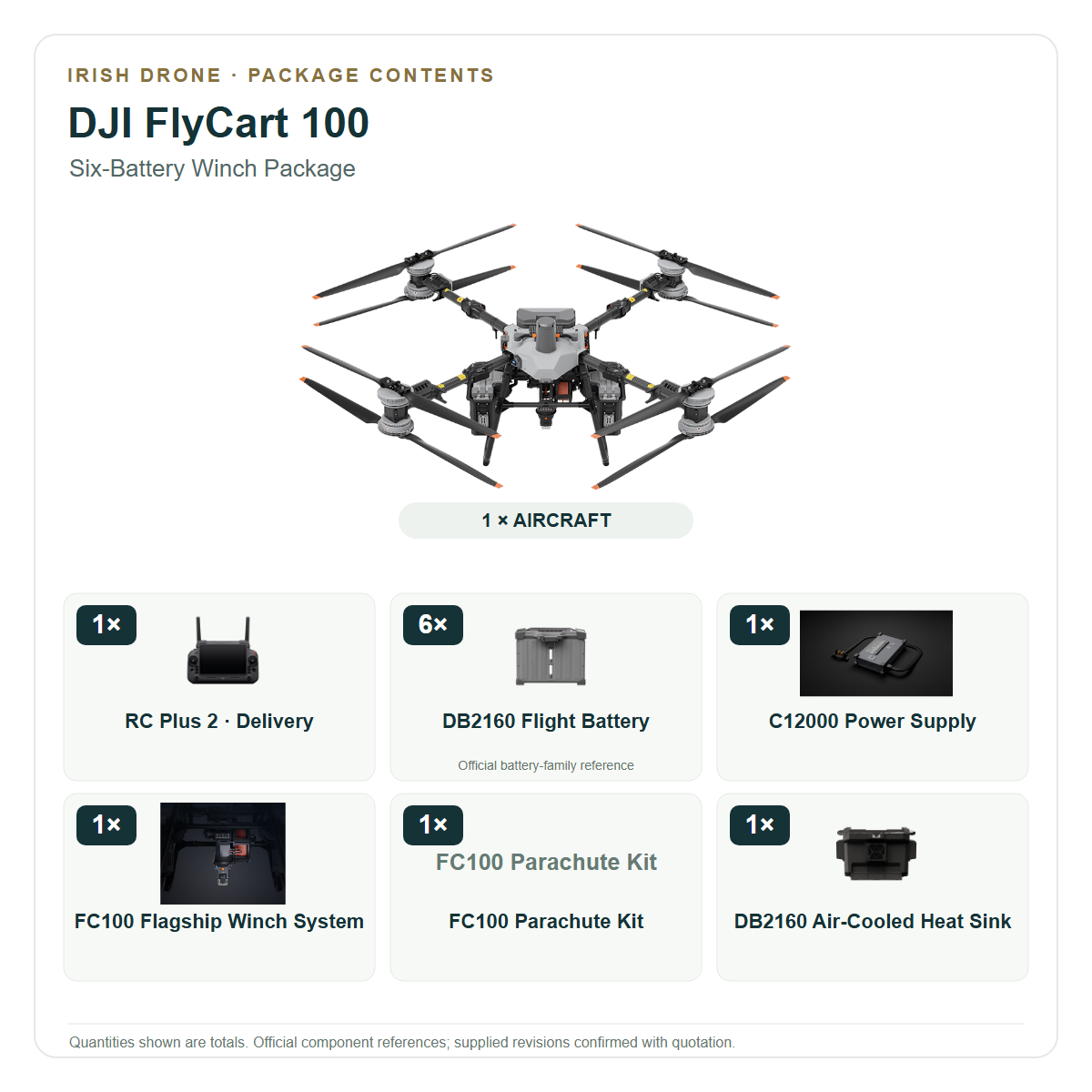
The FlyCart 100 Six-Battery Winch Package gives a concrete six-individual-battery starting inventory, with the listed charger and cooling accessory. It is three candidate dual-battery sets, subject to serviceability and pairing. The FC30 Two-Battery Power Package contains one installed dual-battery set, not a three-stage rotation.
The FC200 Four-Battery DL200 Configuration is a planned, quote-only route. Four supplied batteries represent one four-battery set. European supply and regional compatibility must be confirmed; the catalogue does not establish them.
For FC100, record whether a quotation adds another charger, another verified power route or only more inventory. Those changes answer different bottlenecks. Do not assume optional equipment, fuel or extra electrical capacity is included because a rotation diagram would benefit from it.
Measure sustained output without promising continuous operation
A commissioning log should record complete flights, battery identities, charging start and finish, cooling delays, load-preparation time, interruptions and rejected dispatches. Start with a controlled exercise that fits the operator’s authorisation and reserve policy. Then examine which step actually limits repeat deliveries.
The IAA guidance makes clear that the operator’s permissions, competence and insurance need checking for the operation. Ground-energy planning supports that operation; it does not authorise extra flights or justify removing a weather or battery stop condition.
Ask for a configuration review using the measured cycle and proposed duty window. The honest objective is a repeatable, supportable work rate with clear limits. More batteries can increase resilience and postpone charging waits, while a correctly matched power system can increase replenishment capacity. Neither establishes an unlimited operating claim.
Frequently asked questions
Are three individual batteries enough for three dual-battery sets?
No. Three individual compatible batteries provide one pair and one spare. Three complete dual-battery sets require six individual batteries.
Does six-battery stock guarantee continuous FC100 deliveries?
No. Sustained output depends on charging throughput, cooling, handling, battery state and the actual flight cycle.
Can D14000iE’s AC outlet be treated as a 12 kW charger supply?
No. Its listed 1.5 kW auxiliary AC output is different from its dedicated 11.5 kW DC charging output.
Explore the aircraft and packages
Follow the product page for the exact configuration and included equipment. Equipment selection and operating authorisation are separate parts of the project.


Talk to Irish Drone about your project
Send us the site, task, load or application material, intended operating pattern and available charging supply. We can help scope a suitable aircraft and package and discuss the preparation needed for an Irish operation.
Contact usPlan the next part of your operation

Official sources and technical guidance
These links support specific facts in the guide. Check the current revision and operating conditions when preparing a real project.
DJI’s Chinese-market T200 and FC200 references may require China Mainland to be selected in the official site’s region settings; the default region can display a not-found page. Their regional technical data does not establish an Irish configuration or operating approval.



Pingback: FlyCart Endurance: Hover, Ascent and Reserves | Irish Drone