

A seven-minute reference is not seven minutes available for a delivery, and it is not a climbing test unless the manufacturer explicitly says so.
The current seven-minute references are not climbing-duration claims
The first question is which aircraft and which measurement the number describes. DJI’s current Chinese FC200 page labels seven minutes as maximum loaded hovering time with four batteries. The corresponding loaded two-battery hover reference is four minutes. It does not describe seven minutes of ascent. The FC200 specification is explicit about the label.
The agricultural T200 page separately lists the same loaded four-battery seven-minute and two-battery four-minute hover references. Its ascent/descent speed is a different entry. This is the T200 agricultural lifting platform, not a spraying or spreading configuration. See the exact T200 regional specification rather than assuming that an FC200 document covers it.
FC100 has another seven-minute reference with a different meaning. Mixing these aircraft or replacing the word “hover” with “climb” produces a statement the cited evidence does not support.
Keep the FC200 and T200 hover-test conditions attached
For both Chinese regional 200-series references, DJI describes the loaded and empty hover tests at equivalent sea level, 25°C and no wind, continuing until the batteries are depleted and the aircraft is forced to land. The empty references are twenty-five minutes with four batteries and seventeen with two. An empty-aircraft result is not the loaded result.
These endpoints matter. A demonstration that consumes the battery to forced landing does not include an operator’s landing reserve, a delayed receiving point or an abort branch. It cannot be adopted directly as the working duration for a transport flight.
The references also do not establish Irish availability, European conformity or an accepted route. T200 and FC200 remain quote-only in the catalogue, with their Chinese regional configuration clearly distinguished. Treat their test figures as technical evidence to interpret, not as a promise that the same operating case is available in Ireland.

FC100’s seven minutes belongs to a different test
The global FC100 specifications give a 149.9 kg take-off-weight reference of fourteen minutes in dual-battery forward flight and seven minutes in single-battery forward flight. The corresponding hover figures are twelve and six minutes. Forward-flight results use the stated optimal constant speed; hover results use hovering. Both use the specified sea-level, 25°C, windless conditions and a 0% endpoint.
DJI labels single-battery mode as emergency use. It is therefore inappropriate to promote the seven-minute single-battery test as a normal way to maximise a workday’s payload or reduce required battery stock.
The take-off-weight condition must remain attached as well. Do not transplant a result from that test onto every advertised payload or working system. Airframe, batteries, mounting hardware, cable, hook and cargo together determine the actual configuration being assessed.
Hover time, forward-flight time and ascent speed answer different questions
Hover duration describes remaining airborne without the forward-flight test profile. Forward-flight duration describes a particular moving test. Ascent speed is a rate, expressed in metres per second; it is not an endurance allowance. A maximum rate also does not prove that the aircraft can sustain it for an arbitrary duration at any load.
The distinction is visible even on FC30. Its published dual-battery 30 kg references list eighteen minutes for both flight and hover under their stated tests, while the single-battery flight and hover figures differ. Equal numbers in one configuration do not make the measurement types interchangeable.
A claim such as “seven minutes climbing” needs an explicit climb-test source with the model, battery count, load, profile and endpoint. The current FC200 and T200 sources checked for this article instead describe hovering. That is the verified conclusion, not a reinterpretation of a marketing number.

Build a phase timetable before estimating energy
Describe the proposed mission in phases: pickup and stabilisation, climb, loaded transit, approach, receiving hover or lowering, departure, return, descent and landing. Add the actual contingency branches the operator intends to use. This exposes time spent airborne that a simple horizontal-distance calculation misses.
A useful first bookkeeping expression is mission time = pickup + climb + outward transit + delivery + return + descent/landing. It is only a time ledger. The energy required per second is not necessarily equal across those phases, and the outward and return loads may differ.
Do not convert the timetable into battery percentage by dividing every minute by the seven-minute hover reference. The relevant power demand, conditions and configuration have not been established by that calculation. Use it to identify the information needed for a controlled assessment, not to dispatch the aircraft.
Illustrative ascent arithmetic is not an endurance prediction
Illustrative arithmetic only: an assumed 100 m vertical change at an assumed constant 2 m/s would take 50 seconds, because time equals distance divided by speed. This is not a recommended climb speed, a permitted height or a measured result for any FlyCart model.
That calculation says nothing about the battery energy needed for the climb, acceleration, stabilisation or the following transport phases. Nor does it prove that the chosen constant speed is suitable for the load and conditions. Multiplying a maximum ascent rate by seven minutes creates the same problem in reverse: it invents a sustained climb test that was not published.
For a real proposal, the operator must define the altitude profile in relation to the terrain, obstacles, airspace and authorisation. A vertical difference between sites and height above the relevant surface are not automatically the same quantity.
Reserve is a separate decision from the test endpoint
The operating plan needs enough energy for its return or accepted alternative, delivery uncertainty and the specified landing reserve. There is no universal percentage offered here. The appropriate policy must come from the exact aircraft guidance and the operator’s assessed operation, taking account of battery condition and the actual route.
Ask what happens if the receiver reports “not ready” just before approach, the load is not released as expected or conditions deteriorate on the return. The answer must fit an agreed contingency, not an extra hover until the task eventually works.
Manufacturer flight distance and communication distance are also different measurements, and neither grants a legal operating radius. The EASA Specific-category guidance describes authorisation and geographical-zone considerations independently of product specifications. Energy capability must be adequate for the authorised operation; it does not define that authorisation.

Turn the proposal into a traceable validation record
Before an authorised exercise, record the aircraft and working-system revisions, battery identities and count, complete load, departure state of charge, weather, route profile and planned stop conditions. Log actual charge remaining at relevant phases and the reasons for any return or aborted delivery.
Keep observations distinct from estimates. If a receiving delay did not occur, the exercise did not validate every possible delay. If the route was tested lightly loaded, it did not establish the same margin at a heavier load. A successful isolated flight is not evidence of sustained battery-rotation capacity either.
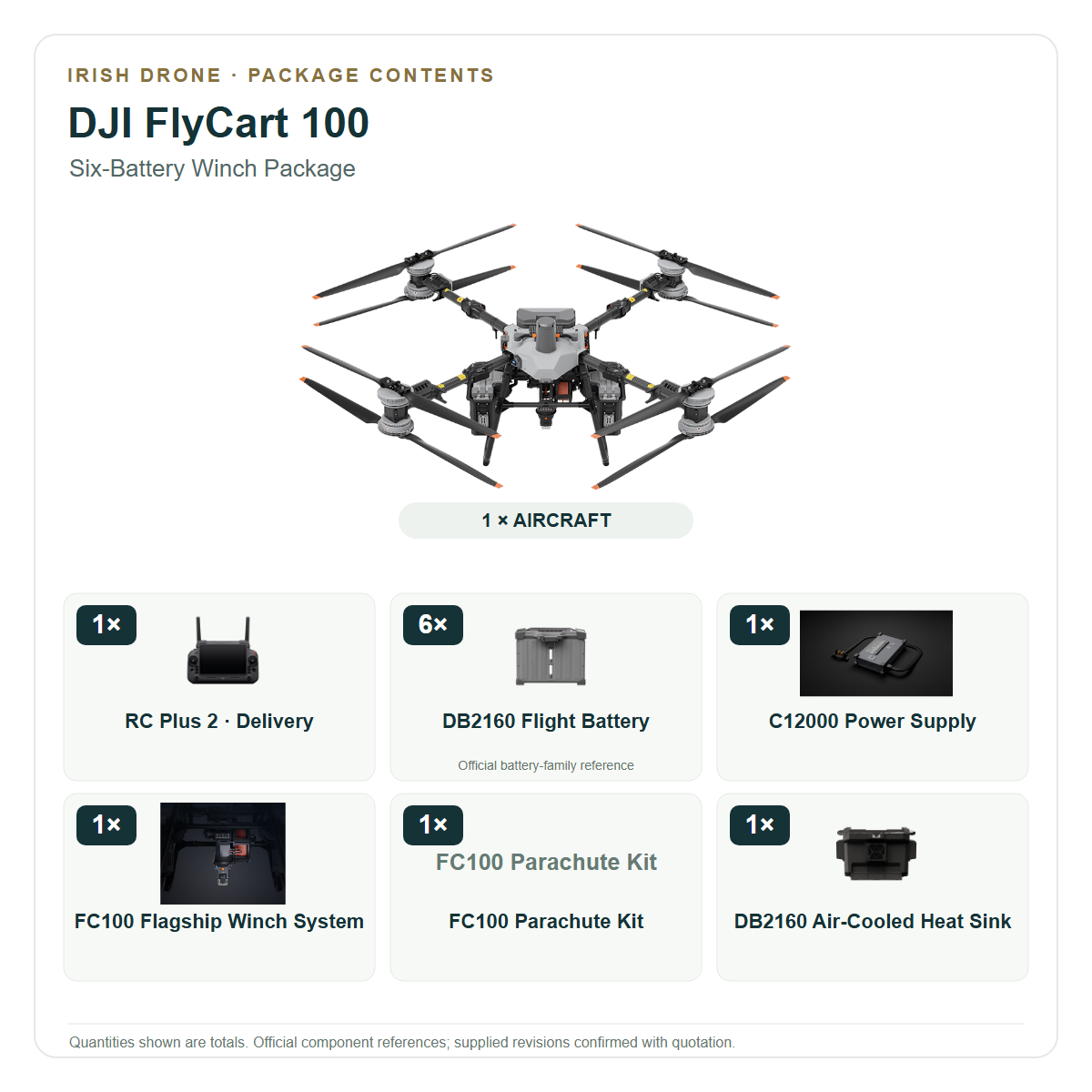
That separation is why the companion battery-rotation guide addresses charging and complete sets, while this article addresses airborne demand and interpretation. Both records are needed when selecting the FC100 Six-Battery Winch Package for a proposed recurring task.
Request a configuration with its conditions visible
Use the technical pages for FC100, FC200 and T200 to identify the source model, then ask for the exact proposed configuration and its applicable documentation. T200 is agricultural lifting; FC200 is the cargo platform. Their similar hover numbers do not make the aircraft or operating systems interchangeable.
Present the supplier and operator with the load, route phases, receiving method, power arrangement and the uncertainties that the exercise must resolve. Keep quote-only regional options separate from a confirmed supply proposal, and keep commissioning evidence separate from a catalogue listing.
The next useful question is not “Can it climb for seven minutes?” It is “What evidence shows that this configured aircraft can complete this assessed mission, including its return and reserve, within the accepted operating conditions?” That question can be tested without inventing a manufacturer claim.
Frequently asked questions
Does DJI call FC200’s seven-minute figure a climb test?
No. The current Chinese specification calls it loaded maximum hovering time with four batteries, at stated conditions until depletion and forced landing.
Is the T200 seven-minute figure different?
The checked T200 page also identifies seven minutes as loaded four-battery hovering time, with four minutes for loaded two-battery hovering.
Can a maximum ascent rate multiplied by seven minutes prove climb capability?
No. It combines separate measurements and invents a sustained climb test, without the required energy and configuration evidence.
Explore the aircraft and packages
Follow the product page for the exact configuration and included equipment. Equipment selection and operating authorisation are separate parts of the project.


Talk to Irish Drone about your project
Send us the site, task, load or application material, intended operating pattern and available charging supply. We can help scope a suitable aircraft and package and discuss the preparation needed for an Irish operation.
Contact usPlan the next part of your operation
Official sources and technical guidance
These links support specific facts in the guide. Check the current revision and operating conditions when preparing a real project.
DJI’s Chinese-market T200 and FC200 references may require China Mainland to be selected in the official site’s region settings; the default region can display a not-found page. Their regional technical data does not establish an Irish configuration or operating approval.


Leave a comment