

Choose the operating category from the actual mission, aircraft and exposure. A farm location or a training certificate does not decide it for you.

Start with the operation, not the brochure
For most proposed Agras application and FlyCart heavy-lifting work in Ireland, the sensible starting point is the Specific category. That is a screening conclusion, not an approval. The operation must be described well enough to establish its actual risk: aircraft configuration, maximum take-off mass, cargo, flight path, people below, neighbouring areas and how the crew will intervene. A small unoccupied field and a busy construction site are different operating environments even if the aircraft is identical.
EASA identifies operations beyond Open limits, including material release and heavier aircraft, as examples of Specific operations. Higher-risk activity may require the Certified framework. Read EASA: Specific category alongside the actual rules rather than treating a dealer’s advertised payload as a legal category. Our practical recommendation is to prepare a one-page mission description before choosing a package. Record the result sought, take-off and delivery locations, intended flight distance and the people controlling both ends.
Keep a written record of the category decision and the reasons for it. Revisit the decision if the task, load, aircraft or route changes; the conclusion belongs to the operation that was assessed, not permanently to a brand or business.
Why Open is a set of conditions
Open is available only when the whole operation satisfies its conditions. It is not simply a rule allowing every drone below 25 kg to fly. Relevant tests include the aircraft’s eligibility for the applicable subcategory, maximum take-off mass below 25 kg, visual line of sight, the applicable height limit, separation from people and restrictions on what is carried or released. Open does not permit dropping material or carrying dangerous goods. These conditions are explained in EASA: Understanding the Open category.
This makes a useful distinction on a farm. A suitable small aircraft taking crop photographs might be planned within Open. Replacing its camera mission with spraying or seed release changes the regulatory analysis even before considering aircraft size. Flying an empty heavy platform is not a general workaround: check its approved maximum take-off mass and the complete rules, not just the payload carried that day. Nor does private ownership of the land remove the aviation rules or the presence of public roads nearby.

Specific has several possible pathways
Specific does not always mean a bespoke SORA. EASA describes standard-scenario declaration, authorisation based on a predefined risk assessment, authorisation supported by an individual assessment, and appropriately privileged LUC arrangements. Each has conditions. An STS declaration is useful only if the operation and aircraft genuinely meet that STS; it cannot be selected because it looks simpler. A PDRA is an assessment framework for an authorisation application, not permission by itself. See EASA: Specific category.
For a proposed agricultural or cargo service, build a comparison sheet with the intended mission in one column and every relevant scenario limitation in the next. Mark a condition as demonstrated, outside scope, or unresolved, with an evidence reference. If a central condition fails, change the mission or investigate another pathway. A restricted demonstration on an accessible site may be a more achievable initial project than an immediate network of remote deliveries, but it still needs the applicable legal basis before flight.
When Certified needs a separate conversation
Do not advertise Specific as a universal solution for any load or route. Article 6 of Regulation 2019/947 deals with Certified operations, including specified high-risk cases and situations where the authority considers that the risks cannot be adequately mitigated without certification. The current EASA rules should be used for this screening. An aircraft’s size alone does not establish the final category, and a parachute alone does not establish that a high-risk route is acceptable.
Cargo description matters. Ordinary spare parts, a battery consignment and a chemical product may present different hazards. Obtain the actual material description and relevant classification before agreeing the operating concept. Agricultural dispensing also has specific technical and legal nuances; it is inaccurate to classify every pesticide application automatically as Certified. Equally, it is unsafe to assume that an agricultural exception covers separate commercial transport of that chemical. Resolve the actual goods, quantity, purpose and consequences with the relevant specialist and authority.
Keep aviation permission separate from task permission
An operational authorisation addresses the aviation operation within its stated limits. It does not independently authorise a plant-protection product, provide land access or remove a geographical-zone condition. The IAA UAM 016: Agricultural applications, May 2024 explicitly treats agricultural aviation and agricultural product rules separately. Its statement that no Irish aerial-spraying derogation had been adopted is dated May 2024; this is a reason to seek current written DAFM confirmation, not to invent a 2026 spraying licence pathway.
Build a permission register for the job. Suggested headings are operator registration, aviation basis, pilot competence, aircraft and configuration, geographical-zone access, site access, material or agricultural permission, insurance and environmental constraints. Give each an owner and a supporting document. A green entry in one row must not make the others green automatically. This register is especially useful when the customer owns the land but the contractor is the UAS operator, because the two parties may otherwise assume that the other has secured everything.

Worked screening example: a remote farm lift
Consider an illustrative project moving sealed fencing components between two privately controlled locations on a hillside. This is a planning example, not a claim about an approved Irish project. Start by documenting component mass, dimensions, attachment method, load behaviour, receiving space, visibility and the route’s relationship to tracks, houses and livestock. Compare a FlyCart configuration with the agricultural lifting role of T200; do not assume their regional documentation or operating conditions are interchangeable.
The legal screening is only the beginning. Check the current IAA geographical-zone information, assess the airspace and ground exposure, and identify whether a suitable predefined route exists or an individual risk assessment is needed. If the proposed load path crosses a public track that cannot be controlled, revise the route before arguing for a buffer on paper. A smaller initial load or closer landing areas may improve feasibility, but neither creates permission without the appropriate assessment and authorisation.
Turn the decision into a purchase brief
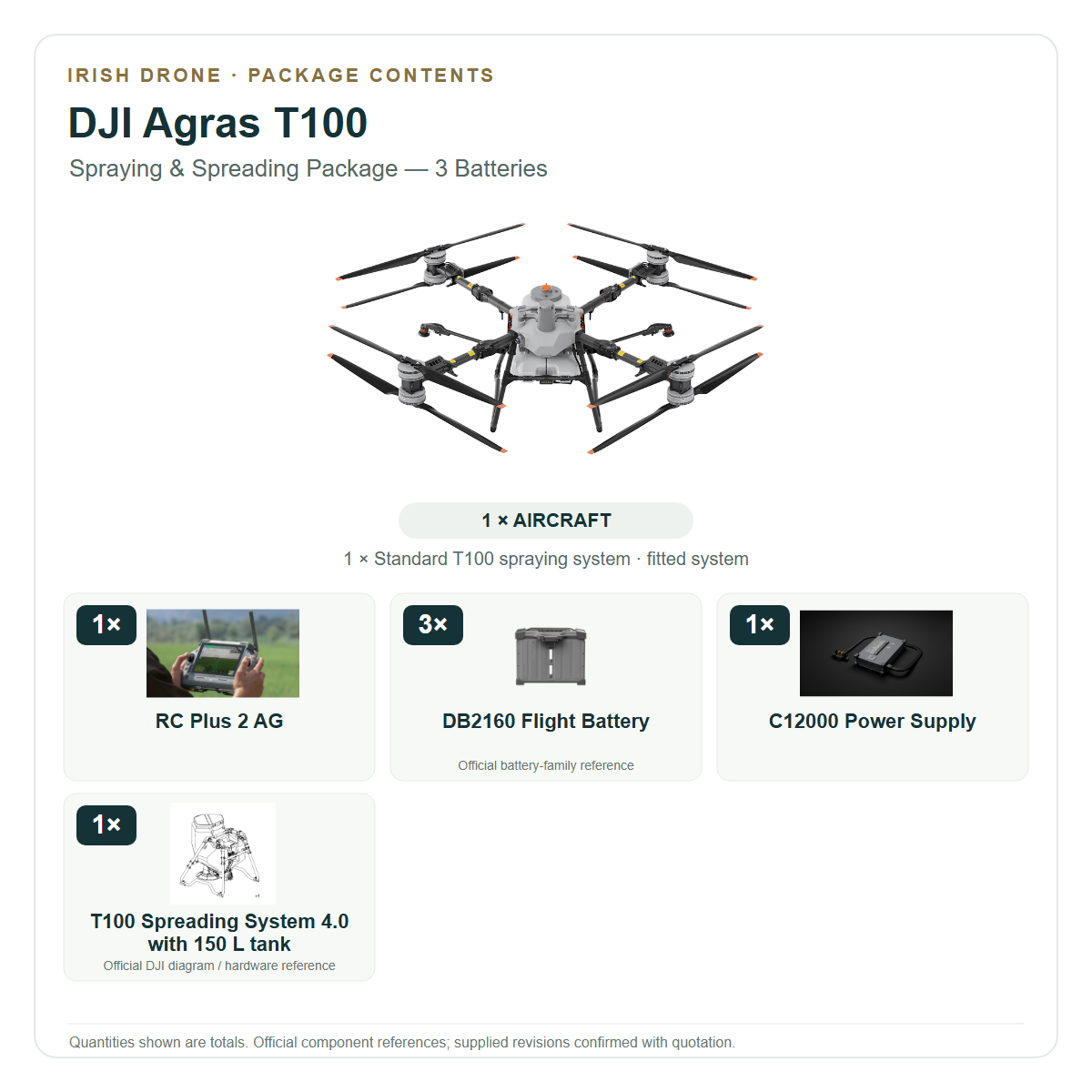
Ask for a configuration-specific brief covering the aircraft, batteries, charging equipment, load-handling hardware, training and the evidence needed for the intended operating route. Package names describe equipment; they do not certify the job. Regional conformity documents, current manuals and any required technical assurance should be checked against the exact aircraft being supplied. A catalogue listing alone is not evidence that a model is approved for Irish operation.
For a SORA-based Irish application, IAA UAM 012, Issue 6, 15 May 2026 currently accepts SORA 2.5 and also explains the expected end-2026 position for SORA 2.0. Do not mix the tables of one version with another. The next step is to define a feasible mission and allocate the evidence tasks, then select the equipment around it. Irish Drone can help you review a relevant Agras or FlyCart package and prepare the information needed to discuss the operating route. The authority decides whether the proposed operation is acceptable.
Frequently asked questions
Is every drone under 25 kg automatically Open?
No. The aircraft and complete operation must meet all applicable Open conditions, including restrictions on material release, people, visibility and dangerous goods.
Does a package include flight permission?
No. Equipment selection, operator authorisation and task-specific permissions are separate matters.
Explore the aircraft and packages
Follow the product page for the exact configuration and included equipment. Equipment selection and operating authorisation are separate parts of the project.

Talk to Irish Drone about your project
Send us the site, task, load or application material, intended operating pattern and available charging supply. We can help scope a suitable aircraft and package and discuss the preparation needed for an Irish operation.
Contact usPlan the next part of your operation


Official sources and technical guidance
These links support specific facts in the guide. Check the current revision and operating conditions when preparing a real project.



Leave a comment